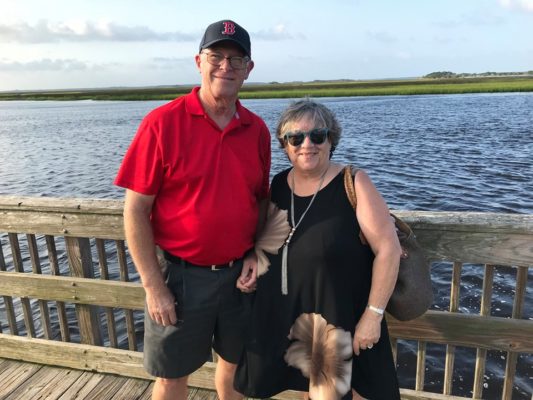
On Wednesday, July 24, Barry Dimick and Melody Dean Dimick have been invited to talk about memoir and writing in general in a Mary Flynn interview on radio station 1520 WBZW AM located at 1188 Lake View Drive, Altamonte Springs. The interview begins about 3:15. Enjoy!
Sometimes it’s hard to know who your friends are, even when there aren’t any cultural barriers to overcome. In his work, Sohrab Homi Fracis documents his experience as an Indian immigrant adapting to American culture—the good, the bad, and the ugly—in the 1980s. Fracis, who now calls Jacksonville home, has gone on to gain recognition for his excellent work, but he walks through life with a perspective inextricably tied to his Asian roots, and the hostility of some Americans to anyone who looks, or speaks differently than them.
Fracis was the first Asian author to win the Iowa Short Fiction Award, which was for his 2001 collection, Ticket to Minto: Stories of India and America. The book was also a finalist for the Flannery O’Connor Award for short fiction. A novella Adaptation of Ticket to Minto was a finalist in Screencraft’s Cinematic Story Contest.
Fracis’s 2017 novel, Go Home, was a finalist in the International Book Awards: Multicultural Fiction category, and it brought him the South Asian Litterary Associations’ Distinguished Achievement Award. The novel was shortlisted by Stanford University for the 2018 William Saroyan International Prize for Writing. His novel excerpt, “Distant Vision,” was nominated for a pushcart prize.
Richard Vaux has done his share of dirty work, but nothing like this. His employer, Trans World Airlines wants him and a crew to sneak into Beirut, Lebanon, at the height of a civil war, to reclaim an airplane hijacked by Palestinian terrorists. TWA can’t say, for sure, whether the plane will fly, or whether it has been wired to explode in flight. And that’s assuming they aren’t attacked by one or more of the rival militias who pass the time shooting at each other across the tarmac, but only because there haven’t been any Americans to kidnap in awhile.
“On June
14, 1985, terrorists associated with a newly-formed Shiite Muslim militia known
as Hezbollah, or “Party of God,” hijacked TWA Flight 847, which was traveling
from Athens to Rome with 139 passengers and eight crew members.
The terrorists first diverted the flight to Beirut, Lebanon, where they
released several passengers in exchange for fuel, fruit and sandwiches. The
plane departed the next day for Algiers, where more passengers were released
before the plane returned to Beirut and one of the hijackers shot U.S. Navy
diver Robert Stethem, and threw his body onto the tarmac.
Lebanese authorities, sympathetic to the hijackers’ demands for the
release of more than 700 Palestinian POWs held in Israel, allowed the murderers
to leave the plane, and replaced them in the middle of the night with a team of
twelve proxy hijackers, with closer ties to the government.
The plane made another lap over the Mediterranean, flying again to
Algiers, where it shed even more passengers, and then back to Beirut, where the
remaining thirty-nine were removed and ferried away to secret locations.
Negotiations continued for another two weeks before the last of the
hostages were flown to Germany on July 2nd. Shortly after the last
hostage was released, Israel released the Palestinians.
For two months, the plane, a Boeing 727, sat on the apron, tattered and
bloody, surrounded by militias shooting at each other across the airport. News
coverage moved on to other events. Hezbollah moved on to other planes.
TWA officials bided their time, relying on contacts at Beirut-based
Middle East Airlines to monitor hostilities and identify a relatively safe
extraction window. On August 13th, they got the call.
Hope McMath grew up in Jacksonville, so being named executive director of The Cummer Museum of Art and Gardens was a dream come true. Her departure, in 2016, was a gut-wrenching inflection point. Opening her own gallery took even more courage. Anyone who has never been inside Yellow House, at 577 King Street, in the CoRK Arts District, need look no further than the backyard. The psychedelic school bus with Rosa Parks at the wheel tells passersby everything that McMath’s Yellow House is about. The space, which doubles as her personal studio, was created to showcase provocative work on topics including racial and gender equity, human rights and environmental sustainability—controversial subjects that were often hard for her to sell to a board of directors. The Yellow House has become a haven for local artists and artistic collaborators of all ages and media, who cite the venue’s reputation as a safe and welcoming space. If that’s not your jam, however, then be advised: Hope is a weapon.