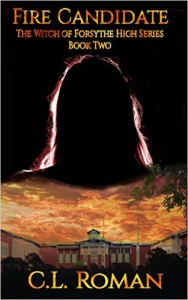
Fantasy author C.L. Roman will launch her latest book, Fire Candidate, the second in the Witch of Forsythe High series, with a blog tour culminating in a FaceBook launch party on March 23rd. She’ll give away three copies of the book, plus a restaurant gift card ($20 value.)
Below find a guest blog where Roman talks about the fantasy genre. Enjoy!
The Oxford Dictionary defines the word fantasy as “the product of imagining impossible or improbable things.” That’s not a bad start for defining fantasy as a genre. However, when you have such a name, it can be challenging to get the literary world to take you seriously.
One of the things that appeals to me most about fantasy writing is that literally anything can happen. You can have sentient storm clouds and flying houses and mice who fence and speak with the facility of an Elizabethan stage actor, because it’s fantasy. Nothing is out of bounds so long as it fits within the plot line.
That said, fantasy is not fluff. The basis of all fantasy stories lies in the question stem, “what if…” What if a boy found out that he was really a wizard? What if a group of siblings was transported to an alternate universe? What if a group of supernatural beings came to Earth and fell in love with humans? Such questions are interesting, not just in and of themselves, but for the deeper ideas they point to about what it means to be human. Heroes and villains in fantasy are experimental models we can mentally climb into for a test drive. In fact, a good book in any genre should be like entering one of those virtual reality games, but with fewer limitations. By immersing ourselves in the world and characters created by a talented author, we are able to safely explore the extreme edges of moral and emotional dilemmas we hope we never have to face in real life. And just like lifting extra weights at the gym, the lessons we learn in those imaginary worlds can strengthen us for the everyday challenges of real life.
The boy wizard begins by searching out who he really is, something all of us must do at some point. The group of siblings must decide whether landing in a new world means finding a new moral center. Their example can inspire us to cling to our own moral code under much more “normal” circumstances. The supernatural beings have to learn that there is a cost to every decision we make; a fact we might ignore or fail to discover on our own. None of these are “light” matters. All of them hold eminently human lessons. The value of fantasy, and indeed of literature in general, lies in its ability to reveal such lessons, allowing us to see the world from a point of view other than our own, and learn from it.
Fantasy is often discounted as “light reading,” or worse, the less than brilliant sibling of science fiction, herself a distant cousin to literary fiction. But don’t sell it short. Considering the lyrical prose and plot complexity created by such authors as Ursula K. Le Guin, J.R.R. Tolkien, and George R.R. Martin, one should resist the temptation to dismiss fantasy as “light” anything. Instead, we should judge the writing by its own merits just as we do any other genre, and thereby enjoy the ride twice as much.